The AI that came to work on our team
On Claude Tag, a paradigm shift, and why a small foundation is faster at this than a big company


An idea I recognised
A few months ago I wrote here about Kamal — our AI-driven management board. Five or so digital specialists that scan their domain every Monday morning and give me a synthesis within two minutes. I built it the hard way: reading, failing, finding the pattern, and then engineering it with budget limits, logging and error handling.
This week Anthropic released something that looks suspiciously like what I’d been building. It’s called Claude Tag, and the idea is strikingly simple: you tag @Claude in a Slack channel, and Claude picks up the work. Not as a chatbot that gives an answer, but as a colleague that breaks the task into stages, gets to work, and comes back when it’s done.
The first time I read it, I thought: this is exactly the exit I was driving towards. Except Anthropic has paved the road.
Why a top scientist is losing sleep over this
The most striking thing didn’t come from the marketing department, but from Andrej Karpathy — co-founder of modern language models, one of the most influential AI researchers around, recently joined Anthropic. He called Claude Tag the third major redesign of how humans interact with AI. Not a feature, but an era.
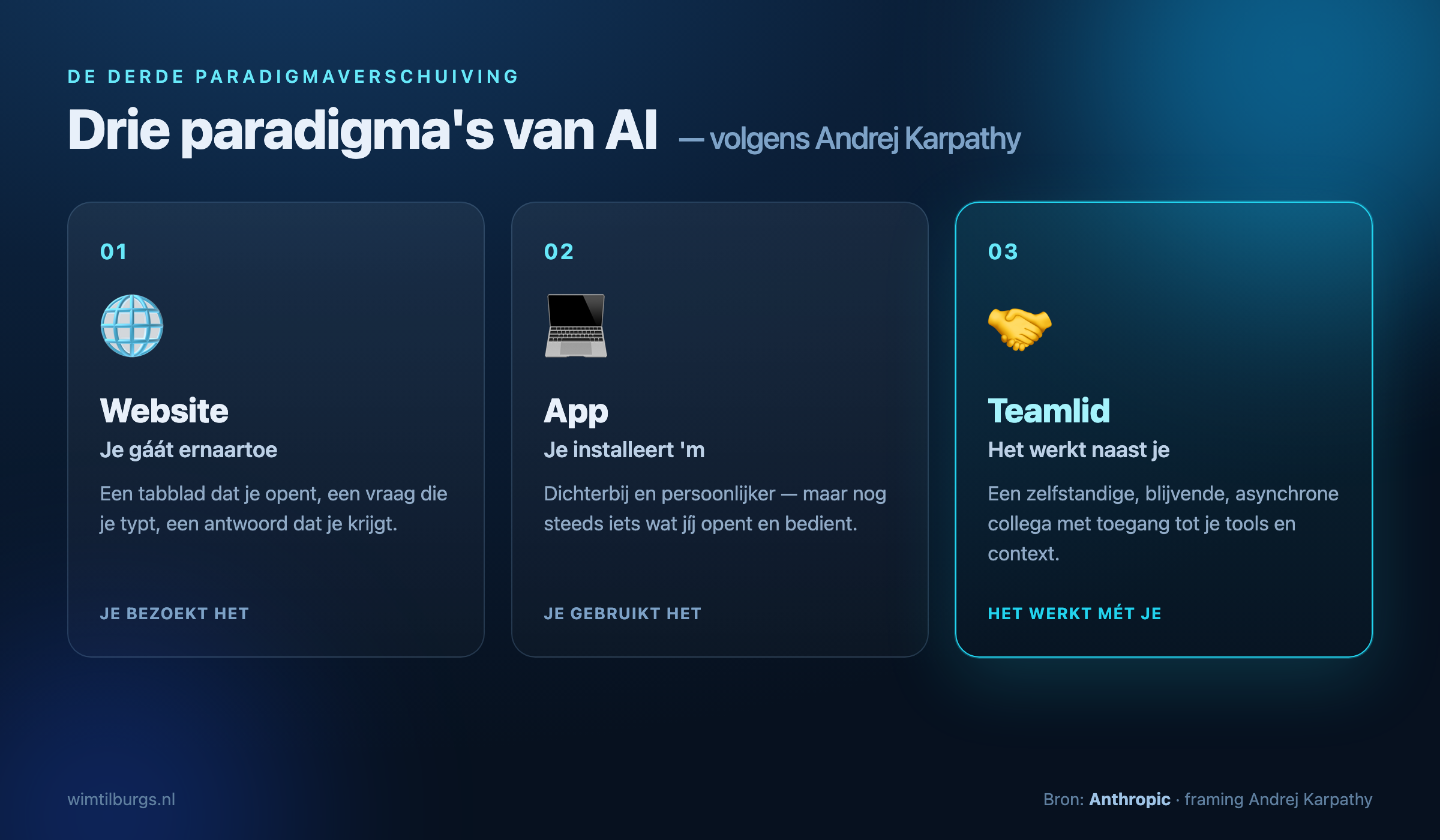
His three paradigms:
- The AI is a website you go to. You open a tab, type a question, get an answer. That’s how ChatGPT began.
- The AI is an app you install on your computer. Closer, more personal, but still something you open and operate.
- The AI is a self-contained, persistent, asynchronous entity with organisation-wide access to tools and context, working alongside teams of humans.
That third one is a leap. The difference between a tool you reach for when you need it, and a colleague who walks along, reads along, remembers what’s going on and contributes of its own accord. Karpathy’s own summary, when people mocked him for “getting excited about a Slackbot”: this isn’t some crappy bot — it’s an org-level harness. The difference will become clear over time.
I believe him. Because I built that harness by hand, and I know how much work sits underneath it.
What Claude Tag actually does
Anthropic deliberately designed it with teams and organisations in mind, and it’s full of details that show they’ve thought it through. A few things stand out:
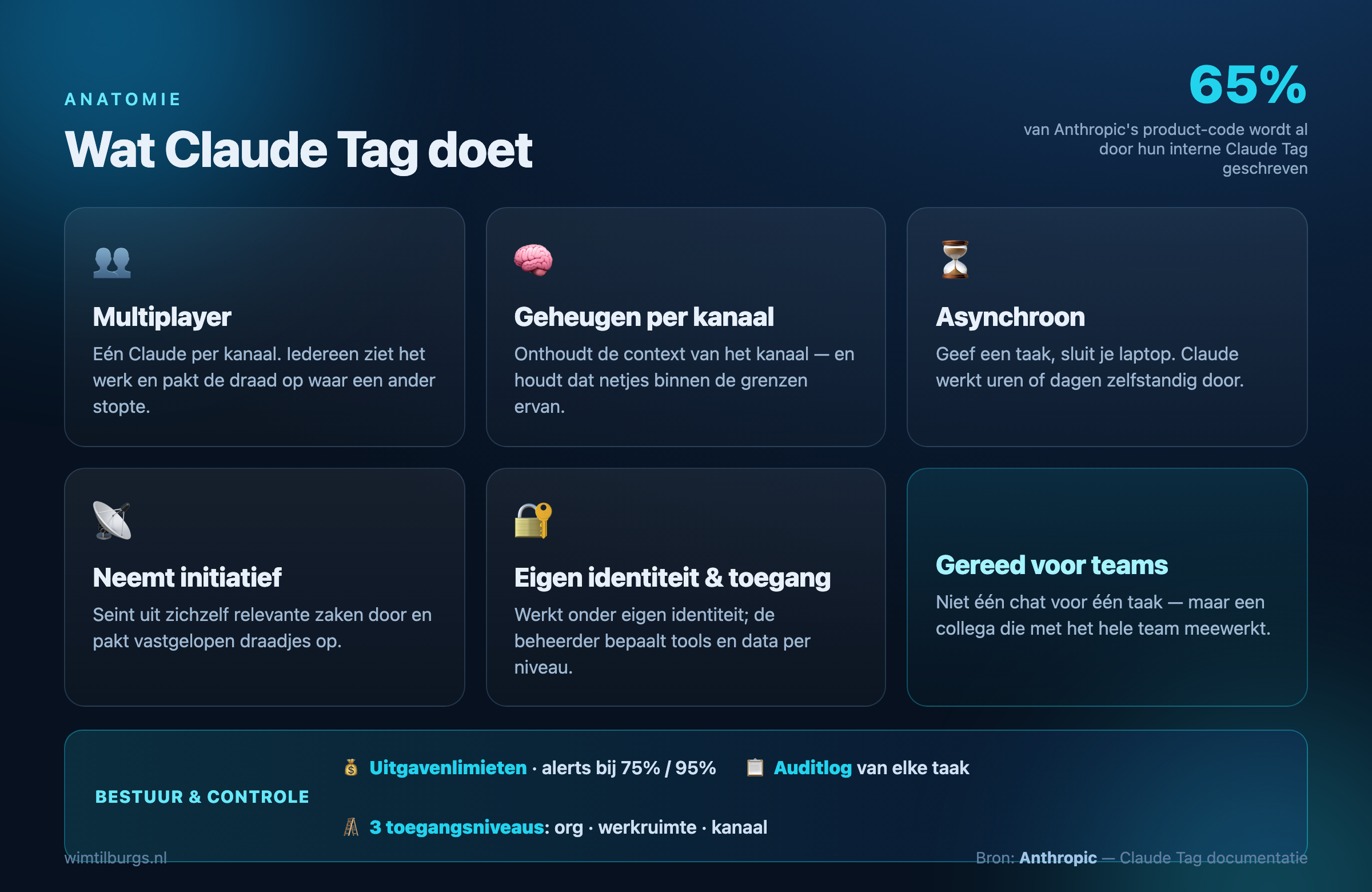
It’s multiplayer. In a single Slack channel there’s one Claude that everyone works with. Everyone sees what it’s working on, and anyone can pick up the thread where someone else left off. That’s fundamentally different from a private chat with a chatbot. It feels like collaborating with a teammate, not operating a tool.
It remembers — per channel. Claude builds context from the channel it’s in. You don’t have to explain what it’s about every time. And the memory stays neatly within the bounds of that channel: a channel for accounting shares no memories or tools with a channel for engineering. From private channels it never reports.
It takes initiative. Turn on “ambient” behaviour and Claude keeps you informed of its own accord — flagging relevant things and picking up stalled threads that no one finished. In the chaos that is Slack, a team member that keeps the overview is no luxury.
It works asynchronously. You give it a task and get on with your own work. Claude can schedule tasks for itself and pursue a project autonomously for hours or days. Anthropic says this has become their internal way of working: they now delegate much of their time to multiple Claudes at once.


And then the part that impresses me most as a builder: identity and access. Claude works under its own identity, and an administrator decides on three levels — organisation, workspace, private channel — which tools, data and even codebases it may touch. Each level inherits the rights of the level above it. There are hard spend limits, per organisation and per channel, with alerts at 75% and 95%. And an audit log shows what Claude did and who asked for it. Work that would exceed the limit is declined — not quietly cut short.
That’s precisely the boring, essential layer — budget, logging, boundaries — I wrote about with Kamal. The difference between a toy and a system that runs every day. Anthropic has built that layer in.
How big is this internally already? According to Anthropic, 65% of their product team’s code is now made by their internal version of Claude Tag. That’s not a demo. That’s how an AI lab does its own work.
The critical voice (that I take seriously)
I distrust praise. So I also listened to Theo Browne — developer, YouTuber, and by his own admission a Slack-hater who found it annoying to have to defend Anthropic. That’s exactly why his verdict is valuable: critical, and yet convinced.
His sharpest insight: the clever thing about Claude Tag isn’t the “tag”, but that they chose the channel as the boundary. Because the hardest part of building AI colleagues is managing context and access. Usually you only have “global” or “per project” — far too coarse. Different teams and tasks need different context. Theo therefore builds separate agents per channel himself, each in its own container, with all the configuration that entails. Claude Tag delivers the same thing — without you having to assemble it yourself. A Slack channel simply maps far better onto how teams actually work than a codebase or a global setting.
But he also has a fair objection, and I’m taking it with me: you’re locked into Claude. The problem isn’t the “tag” part, he says, but the “Claude” part. You can’t choose another model, can’t switch, can’t have one model give a second opinion to another. For anyone who — like me — deliberately wants to be able to work with multiple models, that’s a real sacrifice. You get convenience in exchange for dependence on a single lab.
His final verdict, though, he shares with Karpathy: this is the right direction. And, importantly for anyone without an enterprise budget: those who don’t want to pay for it can achieve much of the same value themselves with open alternatives. That’s exactly the road I’ve walked these past few years — and it makes my own work not obsolete, but confirmed.
Why we’re faster at this than a big company
This is where it gets interesting for a foundation like ours.
We’re small. Twelve people and fifty-nine volunteers, together serving more than 21,000 members and some 690,000 website visits a year. We have no IT department, no innovation board, no quarter full of steering committees. What is usually a disadvantage is precisely our strength here.
Because while a big company is still forming a working group to “investigate the implications of agentic AI”, we’ve already tagged Claude in a channel and it’s running. Lean and mean. We roll out fast, learn by doing, and throw away what doesn’t work. The same technology an AI lab uses to write 65% of its code, we use to do the work of a much larger team with a handful of people.


That, for me, is the real lesson. The future isn’t “AI replaces people”. The future is teams of humans and AI working side by side — and the organisations that master it first aren’t necessarily the biggest. They’re the nimblest. The foundations, the small teams, the people who dare to tag before the policy is finished.
Karpathy says: it’s a new era. I say: it’s just Monday morning. The stand-up is done, the priorities are clear, and there’s work being done — by us, and by the colleague who never sleeps.
Wim Tilburgs has been building with AI agents for years, from Kamal to the management board of Je Leefstijl Als Medicijn (Lifestyle as Medicine). This article is based on the official announcement and documentation from Anthropic, and on the analysis by Andrej Karpathy and Theo Browne (t3.gg).
A word of thanks — and full transparency
That we, as a small foundation, can work with technology of this calibre is made possible in part because both Anthropic and Slack support us as a non-profit.
From Anthropic, the Je Leefstijl Als Medicijn foundation runs on a Claude Team plan, and at the launch of Claude Tag we received — like every qualifying Team organisation with at least ten paid seats — a one-time usage credit of $2,500 for Claude Tag in our shared channels (Enterprise organisations get $25,000). That credit is applied automatically, covers the channel usage billed to the organisation (not private direct messages), and expires on 1 September 2026. After that, consumption-based billing applies — which is why we set the spend limits straight away.
From Slack we make use of the non-profit programme: our workspace jlamhq.slack.com has been moved to the Pro plan free of charge. Slack offers non-profits either free Pro (up to 250 members) or an 85% discount on Pro or Business+. Because Pro is a paid plan, our workspace meets the requirement to run the Claude app — so the two forms of support dovetail precisely.
We think it’s important to be transparent about this: this is not a paid partnership and not an advertisement. It’s gratitude, and the honest note that good tools for a good cause became attainable here thanks to that support.